

Bald Eagles
Handsome and regal, bald eagles are one of the most recognizable birds in the world. Over the centuries they have become a symbol of courage and strength. These majestic birds can often be spotted around Fanshawe Lake but there are many things you may not know about them.
In the late 20th century, bald eagles were on the brink of extirpation due to hunting, habitat loss and pesticide ingestion. Measures, such as banning the use of DDT (a pesticide that weakened their eggshells causing them to break easily) in the 1970s and other recovery efforts, slowed their decline. Populations recovered and their status was downgraded from "endangered" to "threatened" in 1995 and by 2007, they were removed entirely from the list. They now flourish and their recovery is widely considered one of the greatest conservation success stories in North America.
Bald eagles are not bald in the literal sense. The name is derived from old English meaning "white-headed", rather than hairless. A mature adult is mainly brown with a white head, neck and tail. Both sexes have identical plumage, but females are about 25% larger. Juvenile birds do not obtain the distinctive adult feathers until they are four or five years old.
Bald Eagles are powerful flyers. With a wingspan of 2.3 meters (7.5 feet), eagles are well adapted to soaring on thermal convection currents for long periods. Although a large raptor, they are surprisingly maneuverable in flight.
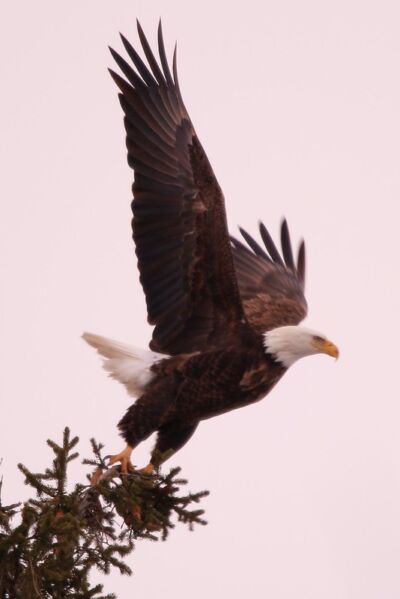
Bald eagles typically prefer to live near large bodies of water where they can readily access food. They are opportunistic feeders that subsists mainly on fish, snatching them from the water with their talons. Despite their reputation as mighty hunters, bald eagles will often steal from others rather than do their own fishing. They are known to harass a hunting osprey until it drops its prey, whereby the eagle swoops it up. Even people and other mammals can lose fish to the bald eagle. They also eat ducks, rodents, snakes and carrion.
Their eyesight is their most developed sense. They can see fish and spot prey the size of a rabbit over a mile away. With their "eagle-eye" vision, they can see four to five times farther than humans and have a field of vision of 340 degrees.
Living 30 years or more in the wild, bald eagles mate for life and reinforce their bond through spectacular flight displays. They court each other by soaring to high altitudes, locking talons and spiraling towards the earth, parting just before hitting the ground. Bald eagles are also known to play with plastic bottles and other objects and have been observed passing sticks to each other in midair.
The adult pair build their nest together, often returning to the same location year after year. They construct their massive nest, or "eyries", near water in tall trees or on cliffs. New material is added to the nest each spring. Since the nests are reused every year, they become very large – up to five meters (16 feet) deep and three meters (ten feet) across and can weigh more than one ton.
The next time you hear the epic cry of a bald eagle on TV, don't be deceived. These formidable raptors have a meek, high-pitched cry. The screaming vocalization often associated with bald eagle in movies is the red-tailed hawk. Their piercing screech sounds more ominous and intimidating, making them the preferred avian voice in Hollywood.
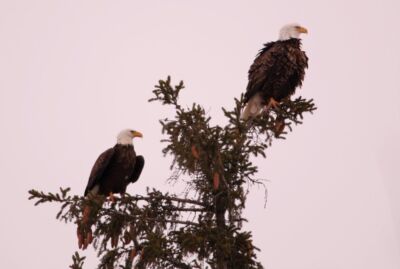
Now that you know more, keep an eye out for bald eagles throughout the Upper Thames River watershed.
Brenda Gallagher, Forestry and Vegetation Specialist