Local Student Wins Conservation Award at Thames Valley Science and Engineering Fair
This April, Upper Thames River Conservation Authority (UTRCA) Education staff helped judge the Thames Valley Science and Engineering Fair at Western University in London. For the past 10 + years, UTRCA staff in conjunction with the Lower Thames Valley and Kettle Creek Conservation Authorities have judged and presented the Conservation Award to a Junior Division (Grades 6-8) project that best explores the topic of conservation with a local focus.
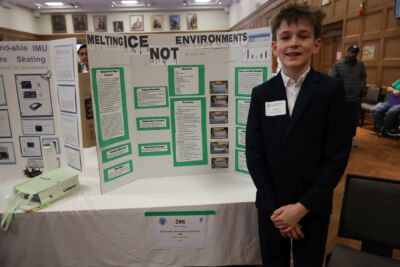
This year’s winner was Harry Boyd from Matthews Hall school. For his project, Renewable Alternatives to De-Icing Salt, Harry investigated whether everyday substances could replace traditional road salt as a de-icer. Testing a range of alternatives, he found that compost leachate — the liquid that drains from decomposing organic material — showed promising results as a potential ice-melting agent.
The topic hits close to home for our watershed. Road salt applied to driveways, sidewalks, and streets doesn’t disappear when the snow melts — it seeps into the ground, mixing with groundwater that many Upper Thames watershed residents rely on for drinking water. Elevated chloride levels also affect the river itself, posing risks to aquatic life and the broader ecosystem that the UTRCA works to protect.
Harry’s focus on compost leachate is a clever angle — it’s a readily available byproduct of composting that could one day offer a practical, low-cost alternative to a chemical that’s surprisingly difficult to remove once it enters our water supply.
To recognize Harry’s achievement, he received a pair of binoculars and the Conservation Award plaque, which will be displayed at Matthews Hall for the coming year. Congratulations, Harry — the Thames watershed is lucky to have young thinkers like you looking out for it.